A small bathroom counter needs room for the things you use and enough clear space to use the sink. Before adding a shelf or a matching set of containers, separate everyday items from refills and occasional supplies. The useful organizer is the one that fits your counter and your routine, not the one holding the most bottles in a photograph.
Choose by the job
- Choose a divided caddy for upright dental and grooming items.
- Choose a tray to gather a small daily selection and lift it away for cleaning.
- Choose a shelf only when its height and footprint leave the sink and cabinet usable.
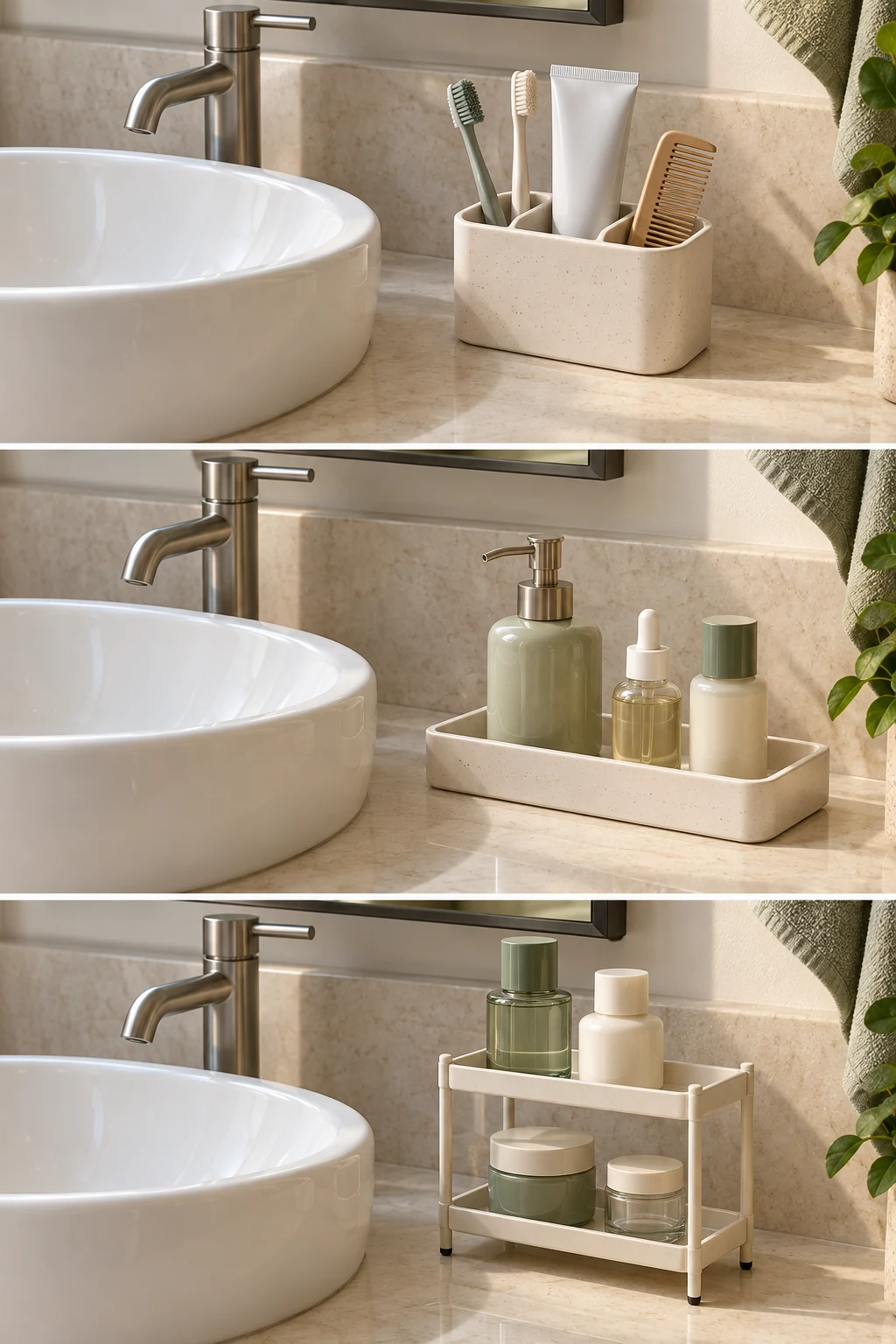
This guide compares three arrangements: a divided caddy, a shallow tray and a compact shelf. They solve different problems. The three-panel image is generated layout inspiration, not a tested installation or an exact merchant product.
Measure the usable counter, not the vanity width
Measure the clear rectangle beside the basin. Leave the tap controls, sink opening and cabinet access unobstructed. If the basin curves outward, measure at the narrowest part of the space the organizer would occupy. A wide vanity can still have very little usable counter on either side of its sink.
Then check height. A mirrored cabinet may open across the area where you want to put tall bottles. A shelf can fit on the surface yet prevent that door from opening. Trace the door's actual movement and allow enough access to lift out the items you use. Do not rely on a photograph to establish clearance.
Try a paper footprint before ordering. Mark the proposed organizer's width and depth, place the paper beside the sink, and carry out your usual routine around it. If you keep moving the paper away, the arrangement is asking more of the counter than it can comfortably give.
A divided caddy for upright everyday items
A caddy makes sense when several small items need separate upright spaces. Group by use: dental items together, frequently used grooming tools together, and a separate place for items that would otherwise disappear behind a bottle. Check the height and width of your actual items against the compartments; the overall size alone does not tell you whether a particular brush or tube fits.
One documented size reference is Joseph Joseph's EasyStore Matt Ecru Bathroom Storage Caddy. Its US product page lists a width of 24.9 cm, depth of 11.9 cm and height of 11.6 cm, divided compartments and hand-wash care. Those measurements are a starting point for a footprint check, not a recommendation that it fits every narrow vanity. The page's rounded inch equivalents differ slightly from exact conversion; use one consistent measurement system when planning.
A non-slip base description does not mean permanent attachment. Keep the organizer on the type of surface and in the conditions described by its maker. Follow the separate storage directions on cosmetics and grooming products rather than assuming every product belongs beside a damp sink.
A shallow tray when you need an easy reset
A tray can gather a small number of daily items while keeping their outlines visible. It is a useful direction when your goal is clearing one group off the counter for cleaning. It does not create extra capacity, so begin with the smallest practical daily selection.
Put tall or awkwardly shaped containers on the paper footprint before choosing a tray. Check that there is enough room to take one out without knocking into the next. A decorative edge, handle or raised rim can change the usable area inside the tray; compare internal dimensions where provided.
Do not fill a tray just because it has room. Leave an accessible place for the item you reach for first. Store duplicates somewhere appropriate to their labels and your available space. The clearest arrangement often comes from reducing the counter's job, rather than increasing the size of its organizer.
A small shelf when height genuinely helps
A shelf can separate short items below from taller items above, but it needs more checking than a tray. Compare the clear height between shelves with your bottles, the footprint with the counter, and the upper level with the mirror or cabinet. Assess access to the rear as well as the front.
Follow the exact product's load, assembly and placement instructions. A freestanding countertop shelf, an adhesive wall shelf and a screwed-in shelf are different installation choices. Do not transfer a wall shelf's advertised capacity to a counter organizer or treat an adhesive product as universally suitable for a rental bathroom.
If a proposed shelf crowds the basin, consider moving occasional supplies to suitable cabinet storage instead. More vertical storage is only helpful if the everyday routine remains comfortable.
Keep the arrangement easy to maintain
Choose a layout you can empty, clean and dry according to the manufacturer's directions. Check how pieces separate, whether small compartments are accessible, and whether your intended location is appropriate for the material. A wood appearance in an inspiration image does not establish moisture resistance or a cleaning method.
Avoid bringing a hair tool or charging device into this arrangement merely to complete a styled photograph. Electrical placement and use must follow the exact device's instructions and the actual environment. This is counter organization guidance, not electrical installation advice.
Start with one measured area and one useful grouping. Reassess after using the arrangement before expanding it across the vanity. For another space-saving decision, compare our bedside storage guide; for a coordinated bedroom, explore the sage and ivory palette. This guide is about storage space, rather than a hair or skincare routine.
Sources and how we made this guide
Original editorial comparison, updated 23 October 2026. Product facts were checked against the Joseph Joseph caddy page and Yamazaki flat tray page. We have not tested these products or the illustrated installation. No merchant photographs or reviews were copied.